
Criminal Court Cases in Franklin Parish
The Fifth Judicial District Court is Franklin Parish's general-jurisdiction trial court. It hears felonies, district-level misdemeanors, juvenile matters, and other district cases. The Franklin Parish Clerk of Court maintains those local files. Winnsboro City Court keeps its own statutory criminal, traffic, and ordinance docket. Wisner and Gilbert mayor's courts handle municipal ordinance matters under Louisiana law.
This split matters. A negative answer from the Franklin Parish Clerk does not rule out a Winnsboro, Wisner, or Gilbert case. Start with the location, arresting agency, and apparent level of the charge. The Clerk is the custodian for Fifth JDC filings, while the sheriff holds law-enforcement and booking records rather than the adjudicated court file.
Fifth JDC, City Court, or Mayor's Court?
Match the event to the court before paying for a search. Fifth JDC records are at 6550 Main Street in Winnsboro. Winnsboro City Court is at 1308 Cornell Street. Wisner Mayor's Court works through Town Hall, and Gilbert ordinance matters route through the village office or police channel.
| Court | Likely Franklin Parish record | Contact |
|---|---|---|
| Fifth Judicial District Court | Felony, district misdemeanor, and district juvenile files | 318-435-5133 |
| Winnsboro City Court | City misdemeanor, traffic, and ordinance docket | 318-435-4508 |
| Wisner Mayor's Court | Wisner ordinance violations | 318-724-6568 |
| Gilbert Mayor's Court | Gilbert ordinance matters; confirm schedule | 318-435-6506 |
Franklin Parish Case Record Searches
Franklin Parish has no verified open public case-detail portal. The dependable route is a phone, counter, mail, or fax request to the proper clerk. The Louisiana Clerks' Remote Access Authority portal may include participating offices, but access, coverage, accounts, and charges vary. Do not assume it replaces the local custodian.
- Identify whether the matter belongs to Fifth JDC, Winnsboro City Court, or a mayor's court.
- Give the clerk a full name, aliases, approximate year, charge, and case number if known.
- For Fifth JDC, request the published $20 criminal-history search and name the exact record needed.
- Review the docket for filed charges, minutes, pleas, rulings, disposition, and sentence.
- Order a plain or certified copy, and ask for an archived-index search when the date is old.
The local search does not have a verified online form, so these are the practical query fields staff need:
| Search field | Use | Notes |
|---|---|---|
| Full name and aliases | Primary party match | Spelling variants can prevent a match |
| Case number | Direct file retrieval | Best identifier when available |
| Date of birth | Identity distinction | Provide only when appropriately requested |
| Approximate year | Index range | Important for manual or archived files |
| Charge or court | Jurisdiction check | Helps separate district and municipal dockets |
Franklin Parish Clerk Counter and Fees
The criminal desk is at the Franklin Parish Courthouse, 6550 Main Street, Winnsboro, LA 71295. Mail goes to P.O. Box 1564. The office lists 318-435-5133, fax 318-435-5134, and weekday hours of 8:30 a.m. to 4:30 p.m., excluding holidays. Ask before visiting about access arrangements and accepted payment because those details are not published.
A Franklin Parish criminal-history search costs $20. Plain criminal copies cost $1 per page, certification costs $10, and fax service costs $5 plus $1 per page. Carrier or postage expense is added at actual cost. State clearly whether the goal is a docket sheet, charging document, minute entry, judgment, sentence, or certified disposition.
The Clerk's criminal fee page shows the source schedule used for these amounts.
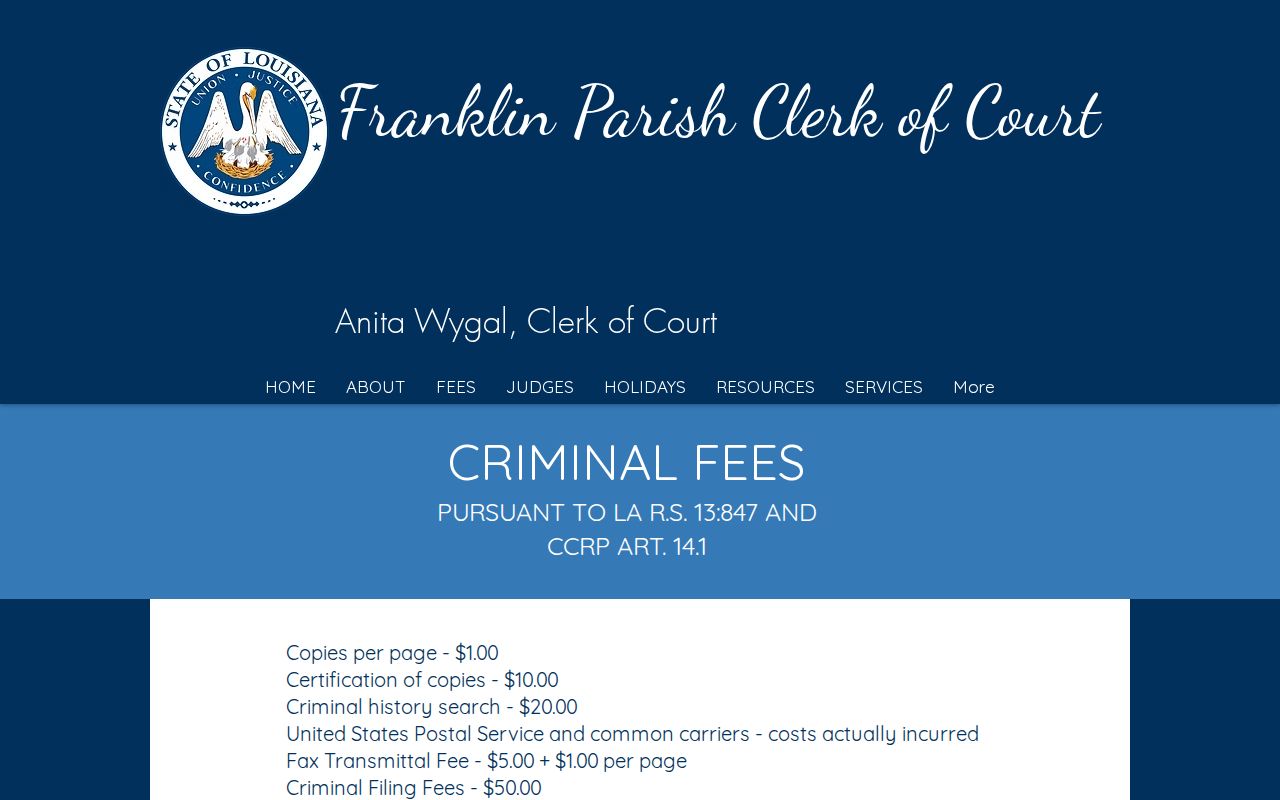
The published schedule makes the local counter the clearest source for both search and copy pricing.
What a Criminal Case File Contains
A court file records prosecution, adjudication, and sentence. It may show that the prosecutor changed or declined an arrest charge, so read each count through its final disposition rather than stopping at the first allegation.
| Case Number and Court | The unique file identifier, division, and court with jurisdiction. |
|---|---|
| Charging Document | Complaint, bill of information, or indictment stating charges filed in court. |
| Docket Entries | Chronological filings, minutes, motions, orders, and appearances. |
| Hearing Dates | Arraignment, motion, pretrial, trial, and sentencing settings. |
| Disposition and Judgment | Outcome for every count, including dismissal, plea, acquittal, or conviction. |
| Sentence and Conditions | Custody, probation, fines, costs, restitution, and related orders. |
When a Franklin Parish Booking Charge Changes
A booking charge reflects the arresting agency's basis at intake. The district attorney then screens the facts and may file a different charge, amend a count, or decline prosecution. That difference is not necessarily an error. The court caption and charging document establish what was prosecuted, while the judgment and minute entries show how each filed count ended.
The Fifth Judicial District Attorney serves Franklin, Richland, and West Carroll Parishes. Its role sits between arrest and the court docket. The Fifth Judicial District Attorney site identifies the office responsible for that prosecution stage.
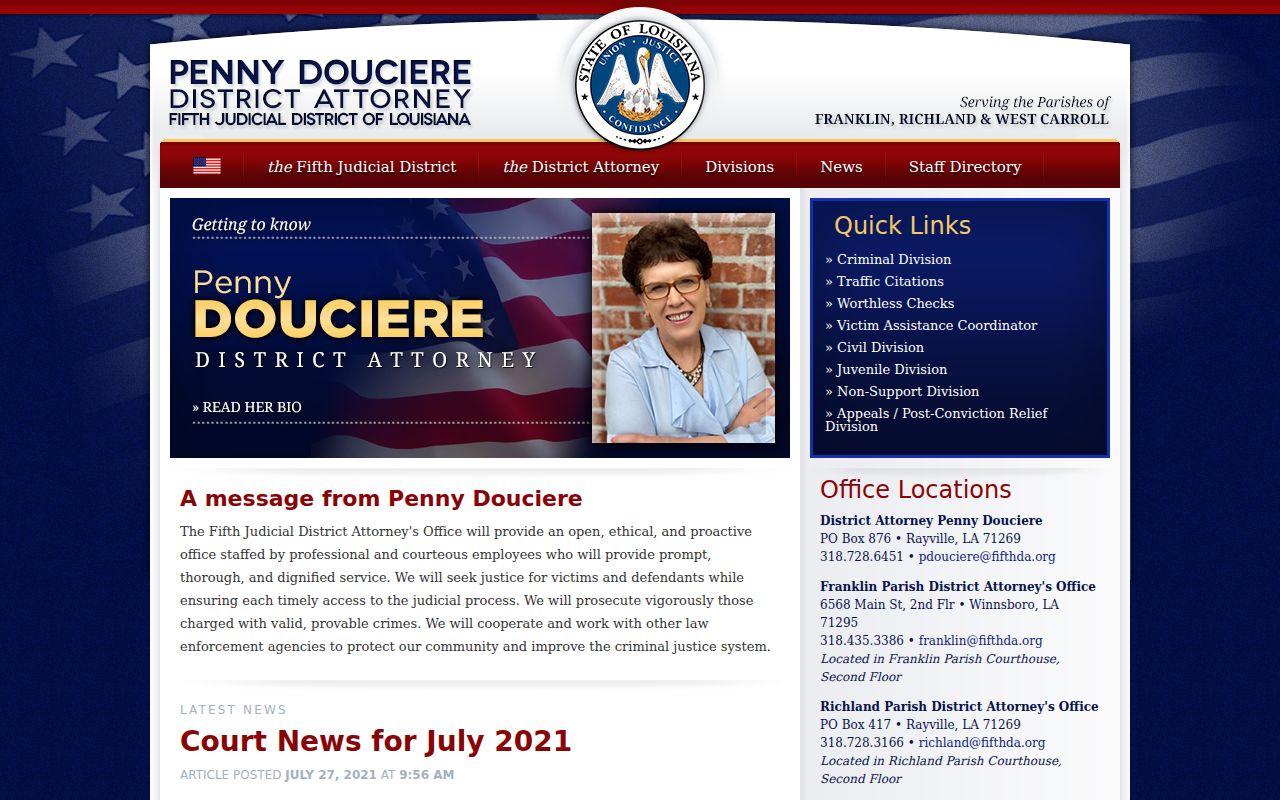
This three-parish district structure explains why Franklin Parish filings and prosecutor functions share a regional judicial district.
Criminal Case Stages in Franklin Parish
After arrest and a prompt initial appearance, prosecutors decide whether and what to charge. Arraignment fixes the plea. Discovery, motions, and pretrial settings follow. The case may end through dismissal, plea, trial verdict, or another disposition. A conviction then moves to sentence and may proceed to appeal.
Case flow: Charges Filed › Arraignment › Pretrial › Plea or Trial › Disposition › Sentencing
Fifth Judicial District local rules govern docket setting and practice. Appeals from Fifth JDC go to the Second Circuit Court of Appeal, whose appellate docket is separate from the Franklin Parish trial file.
Repairing a Missing Franklin Parish Disposition
If a Louisiana Right to Review record lacks an outcome, LSP directs the subject to obtain an original, unaltered certified document from the clerk, district attorney, or city prosecutor. The record must match the name, birth date, arrest date within one day, original and amended charges, result, and sentence for every charge.
Ask the Franklin Parish Clerk for a certified judgment or disposition that supplies those fields. A docket printout without a final result may not be enough. This process links the local court outcome back to the fingerprint-supported Louisiana Computerized Criminal History record without treating the court file and rap sheet as identical records.
Federal Court Cases from Franklin Parish
A federal prosecution does not appear as a Fifth JDC case. Franklin Parish lies in the Western District of Louisiana. PACER supplies federal dockets and filed documents after account registration, while the federal courthouse site provides current court information. Check current judiciary fees before ordering because they can change.
The Western District of Louisiana website is the official starting point for the federal trial court.
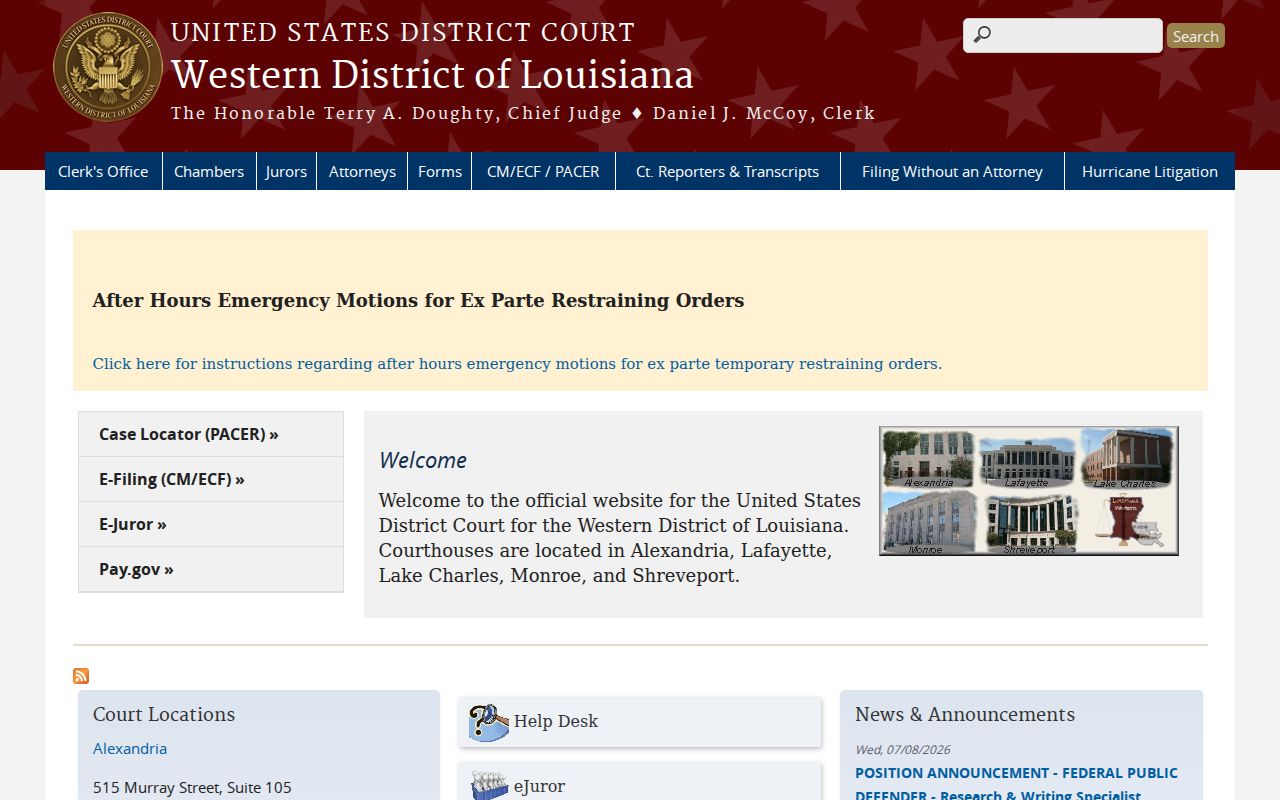
Use it to verify the correct federal division and counter before travel.
For electronic records, the official PACER service searches federal case files.
PACER is a separate federal channel and does not search Franklin Parish district, city, or mayor's court dockets.
Access Rules for Case Records
Louisiana courts are generally open subject to law and court orders, and the Clerk is the practical custodian for filed Franklin Parish criminal cases. Louisiana Public Records Law does not expose every item. Juvenile matters, sealed or expunged records, protected victim and witness information, grand-jury material, and some active-investigation content may be unavailable or redacted.
Request a reasonably described existing record. If material is withheld, ask for the legal basis and whether a segregable, redacted portion can be released. An expunged record is removed from public access but not destroyed, and specified agencies retain access. A missing public result therefore can reflect jurisdiction, indexing, age, or a lawful restriction.
Note: A dismissed count is not a conviction; verify the final result for each count in the court's judgment or certified disposition.